

Email marketing services
Segmentation, campaigns and automated flows
Send useful messages to the people who have agreed to hear from you. We plan segments, campaigns and automated journeys, review deliverability and connect reporting with the actions that matter to your business.
Starting from USD 299/monthFinal scope and price agreed before work starts.
Choose the message and the reason to send it
A useful email programme starts with permission, the source of the list and the customer action it supports. A welcome sequence, a product announcement and an account message have different audiences and requirements. Agree which messages belong in the scope before building automations.
For a store, a lifecycle flow might respond to an order or a permitted abandoned-cart event. For a service business, it might deliver a requested resource and explain the next decision. These are possible workflows, not a claim that every sequence increases revenue.
Connect the platform to reliable data
Review the sending platform, customer fields, consent records and suppression rules. A sequence connected to CRM activity may need workflow automation. Your team approves product facts, offers, timing and the conditions that stop a message.
Authentication, sending-domain setup and list quality are reviewed before launch. A fixed warm-up period or one engagement number cannot guarantee inbox placement. Reporting should distinguish delivery, relevant interactions, unsubscribes and downstream outcomes; opens alone do not establish a sale.
Maintain the flows after launch
Assign someone to check broken links, expired offers, changed products and failed integrations. Test with permitted accounts and keep a way to pause a sequence. Our email automation and ROI guide explains how to keep costs, attribution and measured revenue separate.
Related reading: automation and ROI guide.
What email marketing includes
Automation flows
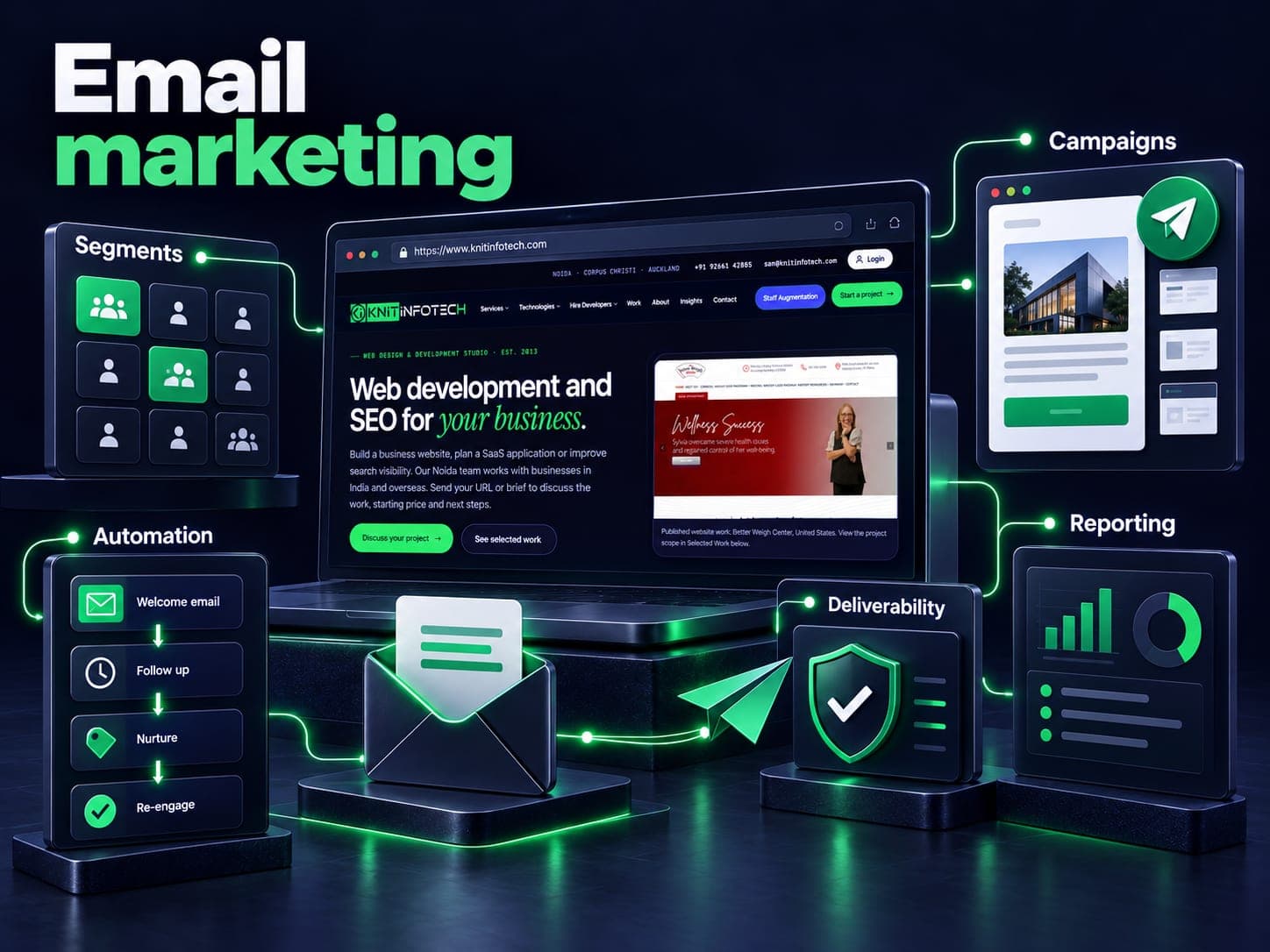
Welcome, browse abandonment, cart recovery, post-purchase, win-back and lead nurture, each path tested with a real address before it goes live.
Campaigns
Launches, offers and newsletters written, designed and scheduled against a calendar you sign off a month ahead.
Segmentation
Lists split by behaviour and customer value, so people receive mail that applies to them and receive it less often.
Deliverability
SPF, DKIM and DMARC records, domain warm-up, suppression rules and inbox placement monitoring.
List growth
Sign-up offers that match why somebody came to the site, plus post-purchase opt-ins that people actually accept.
Reporting
Revenue and leads attributed per flow and per campaign, alongside list health and unsubscribe rate.
Building the programme
Auditweek 1
Platform, list health, authentication records and whatever flows already exist, most of which are usually half-built.
Foundationsweeks 1–2
Authentication fixed, segments defined, templates built to render properly in Outlook as well as everywhere else.
Automationsweeks 2–4
The core flows built in priority order, cart and welcome first because they pay back quickest, each path tested end to end.
Campaign calendarmonthly
A month of sends planned and approved in advance, with room kept for something reactive.
Reportmonthly
Revenue by flow, list growth and deliverability, plus the one flow we intend to rewrite next.
Starting from USD 299/month
An agreed campaign calendar, segmentation and reporting allowance. Email-platform fees and substantial lifecycle-flow builds are separate.
Email, answered
Is email marketing still worth doing?
It reliably returns more per pound than paid channels, because you are not renting the audience from a platform that can change its mind. The catch is that it only works when the mail is relevant, the flows are built, and the messages actually reach the inbox.
How often should we email our list?
Automations send when behaviour triggers them, which might be daily for a busy store. Campaigns go out as often as you have something worth saying, usually two to four times a month. Segmentation matters far more than frequency; the complaint is almost always about relevance.
How do we grow the email list?
A sign-up offer that matches why the person came to the site, a post-purchase opt-in, and content worth subscribing to. Never a purchased list. Bought addresses damage your sending reputation for months and are usually unlawful in the markets we work in.
What are good open and click rates?
Automated flows commonly run 40–60% opens and 5–10% clicks, campaigns around 25–40% and 2–4%. Treat those as sanity checks, not targets. Revenue per recipient is the number we optimise, because a smaller list that buys beats a large one that opens.
How do you stop emails going to spam?
Authentication first, so SPF, DKIM and a DMARC policy that actually publishes. Then a clean list, a steady sending pattern rather than a monthly spike, one-click unsubscribe, and monitoring of inbox placement so problems surface in days.
What does email marketing cost?
Starting from USD 299/month. An agreed campaign calendar, segmentation and reporting allowance. Email-platform fees and substantial lifecycle-flow builds are separate. The proposal confirms the work, fees and responsibilities before you commit.
Make your next email worth opening
Tell us the sending platform, list source and customer action you want to support. We can agree deliverability, campaign and flow priorities.