

AI chatbot development
Knowledge-based answers with human handoff
Help customers find answers from your documents, prices and policies. We build website and WhatsApp assistants with retrieval, approval rules and a clear handoff when a person needs to take over.
Starting from USD 2,499/projectFinal scope and price agreed before work starts.
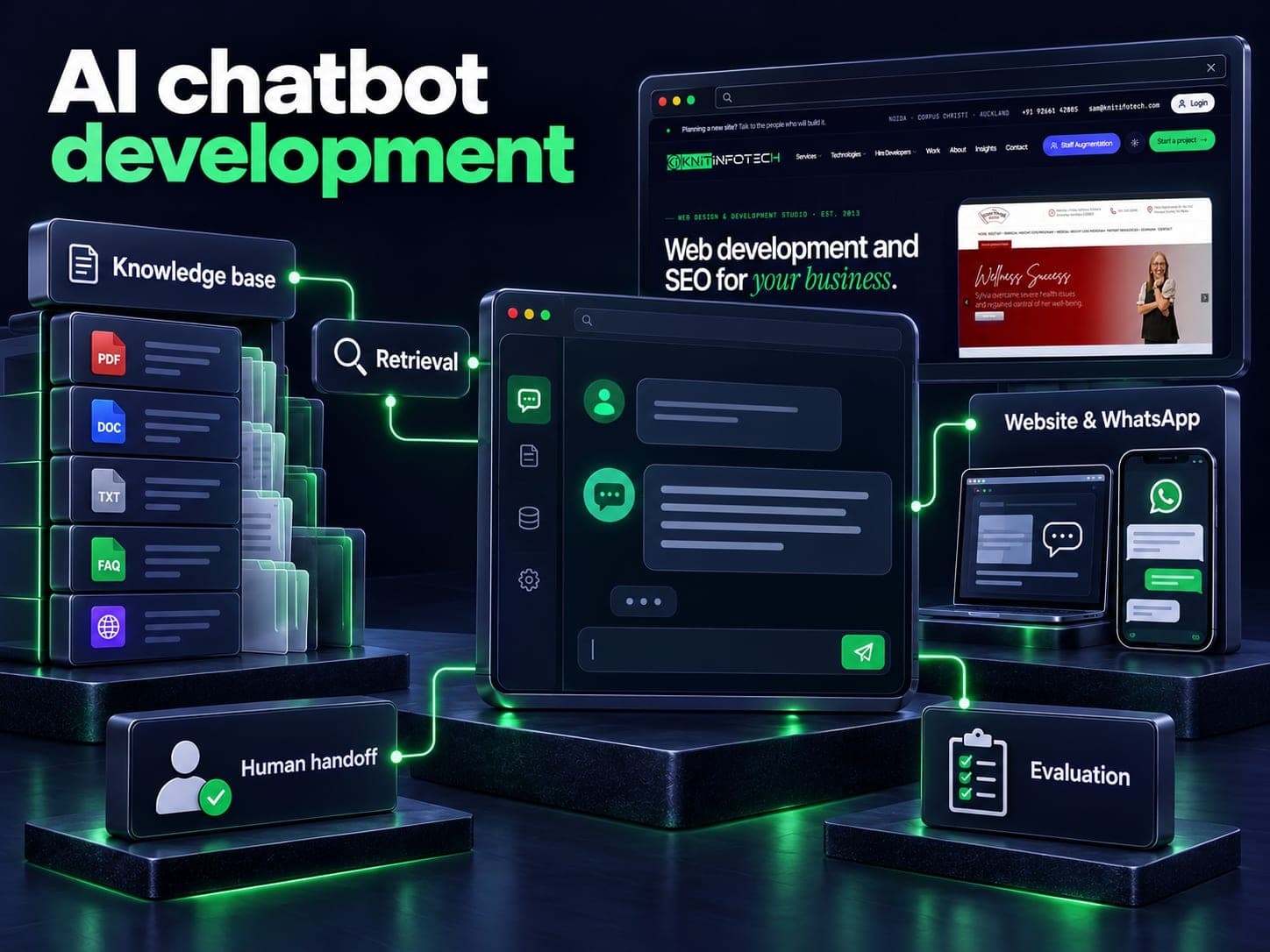
Start with the questions the assistant may answer
Bring a small set of recurring questions and the documents that contain the approved answers. We identify what the assistant can retrieve, what needs a live system lookup and what should go straight to a person. Prices, eligibility, payment adjustments and other commitments need an authoritative source and explicit rules.
A knowledge base helps the assistant find relevant material. It does not make every generated answer correct. The scope includes a review of representative questions, missing information, conflicting instructions and the point at which the assistant should stop and ask for help.
Design the handoff as part of the conversation
For example, a visitor might ask whether a particular service covers their location. The assistant can use approved coverage information, collect the details needed for an enquiry and hand over the conversation when the request falls outside those rules. This is an illustrative workflow, not a claimed automation rate.
Website chat, WhatsApp and help-desk integrations have different access, messaging and account requirements. We confirm the supported channel, information sent to each provider and retention arrangements before implementation. Updating an order or CRM record may need a separate workflow automation scope.
Test and maintain the answers
Agree an evaluation set, failure categories, escalation route and person responsible for keeping source material current. The release should make it possible to review errors and restrict unsupported actions. Ongoing monitoring and content updates are specified in the proposal.
What an assistant build includes
Knowledge base & retrieval
Your documents, FAQs, price lists and policies indexed privately, with a sync so an updated PDF reaches the assistant the same day.
Website & WhatsApp channels
One assistant across web chat, the WhatsApp Business API and Instagram, with the tone adjusted per channel.
Human handoff
Escalation to your team or help desk carrying the full transcript, so the customer never repeats themselves.
Guardrails
Scope, tone and the list of things it must never promise, written down, enforced in the prompt and tested adversarially.
Evaluation
A scored test set built from your real questions, run before launch and again every month against the live assistant.
Analytics
Top questions, resolution rate, handoff rate, and the log of questions it could not answer, which doubles as a content plan.
From audit to a live assistant
Question inventoryweeks 1–2
We read a month of your chats and emails and count what actually repeats, rather than guessing at the scope.
Scope & guardrailsweek 3
What it will answer, what it will refuse, when it hands over, and which documents count as the source of truth.
Build & indexweeks 3–6
Retrieval index built from your content, channels connected, and the escalation path tested with your team.
Pilot behind a flagweeks 6–8
Live for a share of real traffic, with every conversation reviewed and the eval set scored before it goes to everyone.
Runongoing
Monitoring, a monthly accuracy review, and the unanswered-question log turned into new content.
Starting from USD 2,499/project
One scoped business assistant grounded in an agreed knowledge source and channel. Additional channels, integrations and complex workflows are scoped separately. Model, hosting and platform usage are separate.
AI assistant, answered
What can an AI chatbot actually answer?
Whatever is documented: hours, pricing, availability, policies, how-to questions, and order status where we can connect to your system. Anything outside that gets handed to a person, which is a design decision rather than a limitation we are apologising for.
How do you stop it making things up?
Answers come only from retrieved passages of your own content, with citations, and the model is instructed to say it does not know rather than fill a gap. Then we test that with an evaluation set, including deliberately awkward questions.
Which AI models do you use?
Claude or GPT for most work, chosen on the task and on where your data is permitted to be processed. Gemini when Google Workspace is already the system of record. We are not tied to a vendor and will move you if the economics change.
Is our data safe?
Your documents sit in a private retrieval index that we host for you, and nothing you provide is used to train a third-party model. The data flows are written down before the build starts, and we sign an NDA before seeing a single file.
How much does an AI chatbot cost?
Starting from USD 2,499/project. One scoped business assistant grounded in an agreed knowledge source and channel. Additional channels, integrations and complex workflows are scoped separately. Model, hosting and platform usage are separate. The written proposal confirms deliverables, exclusions, timeline and the final price before work starts. Hosting, licences, platform subscriptions and usage charges are separate where required.
How long does it take to build?
Three to six weeks in most cases, plus the two-week readiness audit if you want the wider picture first. The pilot period at the end is not padding; it is where the awkward real questions show up.
What should your chatbot help with?
Share a few anonymised recurring questions and the approved information behind them. We can discuss the supported channel, handoff and review requirements before access is granted.