

AI for ecommerce
Product discovery, catalogue support and customer assistance
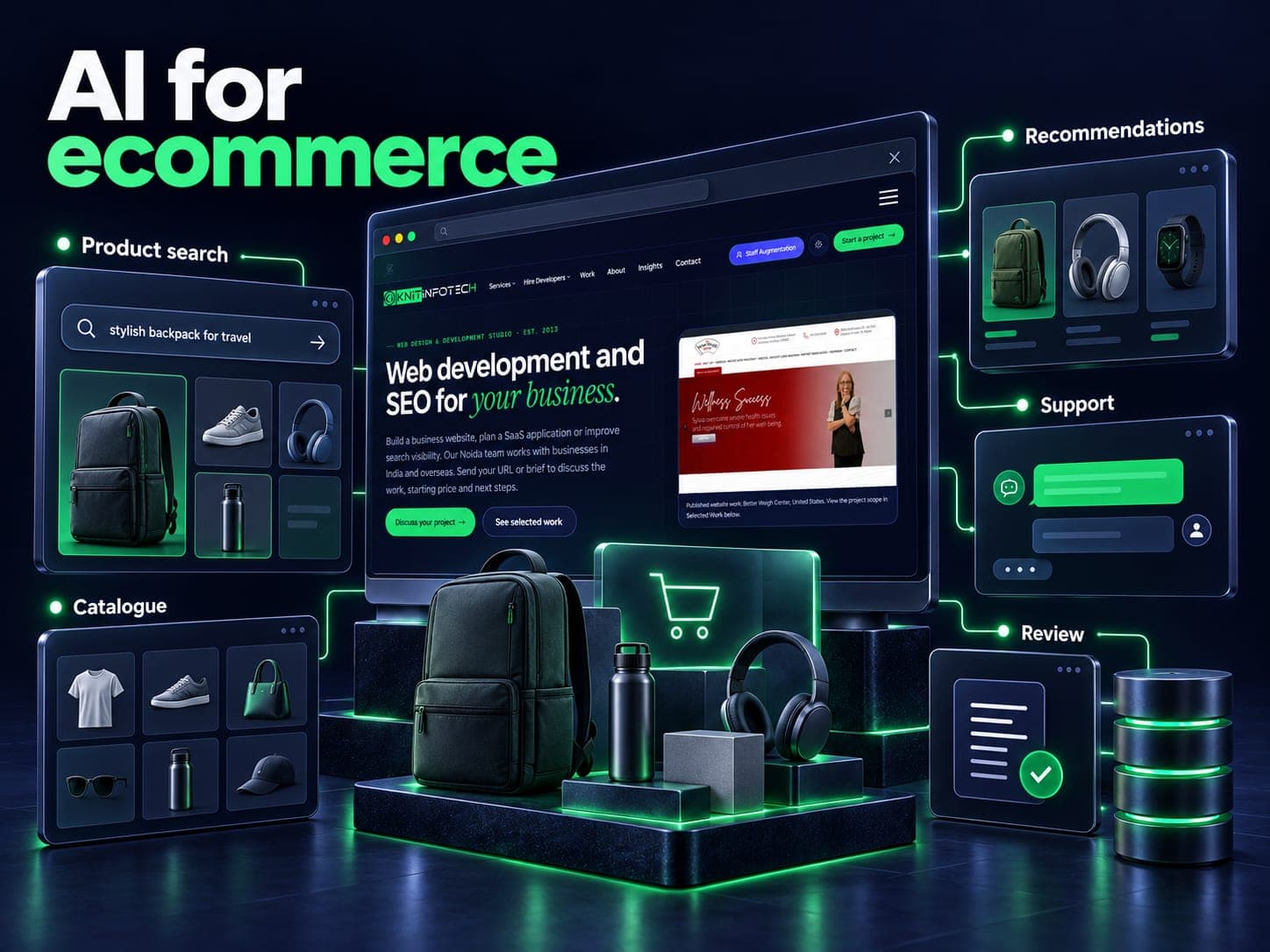
Help shoppers find suitable products and give your team better tools for catalogue work. We scope search, recommendations and support assistants around product data, existing integrations, review controls and measurement.
Starting from USD 2,499/projectFinal scope and price agreed before work starts.
Choose one store problem to test
An AI project needs a specific task before it needs a model. Start with evidence from the store: searches that return no useful result, repeated support questions, missing product attributes or a recommendation placement you want to test. Agree how you will measure the change and what the current experience does well.
Search and product discovery
Semantic search can help match a customer's wording to your catalogue. It still needs accurate product information, availability, merchandising rules and a useful result when no suitable product exists. We scope the integration against your platform and test representative queries before a release.
Recommendations need a business objective and an evaluation plan. Compare the pilot with the existing experience where traffic allows, and check relevance, product availability and downstream purchases. A higher click rate on a widget does not by itself establish increased revenue.
Support and catalogue workflows
A support assistant can answer approved product questions and, with suitable permissions, look up an order. Customer verification, account access and the handoff to a person belong in the design. See AI chatbot development for the conversation workflow.
Catalogue work can include drafting descriptions or suggesting attributes for a review queue. Staff approve the product facts before publication; generated text must not invent a specification, compatibility claim or delivery promise. Keep the catalogue and ecommerce SEO requirements aligned.
Check the platform before promising the integration
Send the store platform, relevant plugins or APIs, sample data and the task you want to improve. We confirm access, supported operations, running costs and test conditions in the scope. A missing integration or checkout problem may need ecommerce website development first. Our CMS and ecommerce services cover the underlying platform work.
Release one capability at a time, with logging, an agreed fallback and someone responsible for reviewing failures. A pilot can establish whether the approach is useful for your store; it cannot guarantee a sales uplift.
What we build for stores
Semantic search
Search that understands intent and tolerates typos, with your merchandising and stock rules layered on top rather than overridden.
Recommendations
Cross-sell and upsell weighted for margin and discovery, not just click-through, and always measured against a holdout group.
Support assistant
Order status, returns, sizing and product questions answered from your own data, with the customer verified before anything is disclosed.
Explore →Catalogue enrichment
Attributes, descriptions and translations drafted across thousands of SKUs and pushed through a review queue before anything goes live.
Pricing & stock signals
Alerts from your sales and inventory data: lines about to sell out, products dead for ninety days, margins drifting the wrong way.
Measurement
Every capability A/B tested or held out, with the result reported even when it is that the feature did nothing.
One capability, start to proven
Pick the capabilityweek 1
From your analytics: search exit rate, ticket categories, catalogue gaps. Whichever of the four has the most money sitting behind it goes first.
Define the winweek 1
The metric, the holdout size and the threshold that would make it worth keeping, all agreed before anybody builds anything.
Build & connectweeks 2–5
Integration with Shopify, WooCommerce, Magento or your headless stack, plus whatever your existing search or helpdesk tooling supports.
Pilot against a holdoutweeks 5–8
Live for a share of traffic while the rest carries on as before, until the difference is large enough to be believed.
Keep, kill or tuneweek 8
The numbers decide. If the lift is not there we say so and either tune it or turn it off rather than declaring victory.
Starting from USD 2,499/project
One scoped store-assistant capability and pilot. Catalogue access, integrations and handoff are agreed before quoting. This does not include every AI capability in one fixed build. Usage and platform costs are separate.
Ecommerce AI, answered
Which ecommerce platforms do you work with?
Shopify, WooCommerce, Magento and headless stores. Where you already pay for a search or helpdesk tool, we would rather configure that properly than sell you a replacement, and we will say when the existing tool is genuinely the limit.
Will recommendations just push the same bestsellers?
That is what happens when the only objective is click-through, and it is why so many recommendation widgets feel useless. We set the objective with you, weighting margin and discovery alongside clicks, and check the result against a holdout.
Can the assistant see customer orders?
Yes, once the customer is verified through an email or order-number check. That is what turns it from a FAQ widget into something that resolves tickets, since most support contact is a question about a specific order.
How is generated catalogue content reviewed?
Everything goes into a review queue and nothing publishes unreviewed. For a large catalogue that means a person approving in batches, which is still an order of magnitude faster than writing two thousand descriptions from nothing.
How much does AI for ecommerce cost?
Starting from USD 2,499/project. One scoped store-assistant capability and pilot. Catalogue access, integrations and handoff are agreed before quoting. This does not include every AI capability in one fixed build. Usage and platform costs are separate. The written proposal confirms deliverables, exclusions, timeline and the final price before work starts. Hosting, licences, platform subscriptions and usage charges are separate where required.
How long does each capability take?
Four to eight weeks including the pilot period, which is the part that cannot be compressed because it needs enough traffic to be conclusive. A store with modest volume may need longer before the holdout comparison means anything.
What could work better in your store?
Send the store platform and a recurring search, support or catalogue problem. We can define a limited pilot, its fallback and the evidence needed to review it.