

One accountable person
A named delivery lead from proposal to a year after launch. Not a rotating account manager, and not a shared inbox.
Web & App · 10
Search & Paid · 10
Growth & Social · 7
AI & AutomationNEW
Share your website URL and priorities. We review the details, share audit findings and then discuss next steps.
Frontend
Backend
Cloud & DevOps
CMS & Ecommerce
CRM & ERP
AI & Data
Developer rates start at USD 18/hour. Python, native mobile, Flutter, CRM and Shopify roles start at USD 22/hour. Review profiles and confirm the final scope and fee.
Northeast & Atlantic
Midwest & Great Lakes
Vetted software engineers, React and Next.js developers, Python and AI engineers with genuine US timezone overlap.
Five stages, each ending in something you can open and check. The standing rule underneath them is simple: you should never have to ask what is happening on your project.
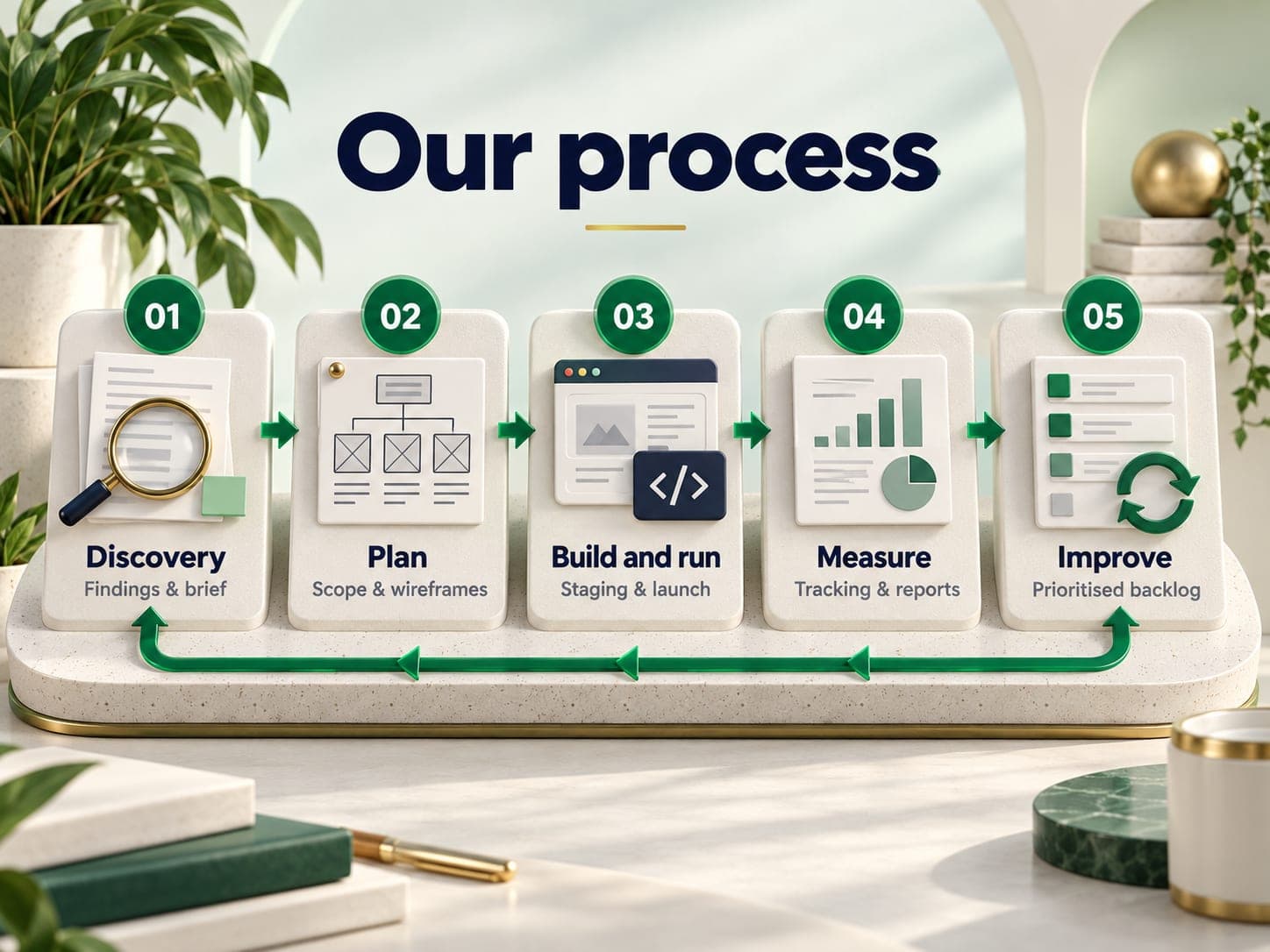
Most agency processes are drawn to look reassuring on a slide. Ours came from thirteen years of noticing where projects actually go wrong, and putting a checkpoint at each of those places.
Projects fail at the start, not the end. The expensive mistakes are almost always decisions made in week one on incomplete information: the wrong platform, a content model that cannot hold the real catalogue, a redirect map nobody checked. So we spend real time on discovery and we write the findings down, in a document you keep whether or not you hire us. If discovery says you do not need the thing you asked for, we will tell you, twice this year that has meant talking a client out of a rebuild they had already budgeted.
A plan nobody can read is not a plan. You get a scope document with the assumptions listed next to the price, a delivery schedule with dates rather than "phases", and a definition of done for each deliverable. Something always changes on the way, and when it does we quote it as a written change request before the work starts, rather than as a surprise on the invoice.
Build and run are the same team. In most agencies the build team disappears at launch and a support desk inherits a system it has never seen. We do not split those roles. The engineers who ship your site are the ones who run it afterwards, which is why post-launch fixes take hours instead of weeks and why nobody bills you for "familiarisation".
Measurement decides what happens next. Before anything goes live we agree what success looks like as numbers: organic sessions to money pages, cost per qualified enquiry, checkout completion rate, Core Web Vitals. Then we instrument for those numbers. After launch the monthly report starts with them, says plainly whether they moved, and proposes the next thing to try. If one went the wrong way, that is the opening line, not a footnote on page nine.
Improvement is a loop rather than a phase. A website is never finished; it is only current. The last stage feeds straight back into the first, and the backlog is scored on impact against effort so next month's work is chosen by evidence rather than by whoever shouted loudest. You can see that backlog, and you can reorder it.
Underneath all five stages, three habits do most of the actual work: one named person accountable for your account, everything written down where you can see it, and bad news delivered early. The last one is the hardest and the one clients thank us for most.
Timings below are for a typical marketing website or a retainer's first quarter. Larger platform work stretches stages 1 to 3; the shape stays the same.
We audit what exists: technical crawl, analytics, rankings, competitors, and the interviews nobody enjoys but everybody needs. We look at your sales data, not just your traffic, because the goal is enquiries that close.
You getScope, sitemap, content model, wireframes for the templates that matter, and the measurement plan. Everything is written down and priced with the assumptions visible, so the number does not move unless the scope does.
You getTwo-week sprints with a staging link that is always current. For retainers this is the campaign work itself: pages shipped, ads live, content published. You see progress continuously instead of at a reveal.
You getGA4, Search Console and call or form tracking configured before launch, not after. The monthly report opens with the numbers we agreed in stage two and says whether they moved.
You getThe backlog is scored on impact against effort and reordered every quarter with you in the room. Tests are run one variable at a time so we can tell what actually caused the change.
You getA named delivery lead from proposal to a year after launch. Not a rotating account manager, and not a shared inbox.
Scope, decisions, change requests and reports live in a shared space you keep access to, including after the engagement ends.
If a date is going to slip or a tactic is not working, you hear it in the week it becomes clear, with what we propose to do instead.
Ownership, account access, payment and handover follow the signed agreement and our terms. Confirm these arrangements before work starts.
Eight to twelve weeks for a marketing site of 8–20 pages, discovery to launch. Ecommerce builds and platform migrations run 12–20 weeks depending on catalogue size and integrations. The biggest variable is not our capacity. It is how fast content and approvals come back from your side.
One named decision-maker who can approve work, content and logins within five working days of a request, and feedback consolidated into a single response per review round. When we are blocked for more than ten working days we re-plan the dates and tell you why.
You can, and most projects do. We quote the change as a written change request with its own price and schedule impact, you approve it, and only then does it enter a sprint. Nothing gets built and invoiced without that approval.
Yes, from the first sprint. It is updated every two weeks with a change log, so you are never waiting for a big reveal and we are never a month down a path you would have vetoed.
Post-launch support follows the agreed scope. A care plan or monthly programme can cover ongoing work. Scope, fees and response arrangements are stated in the written proposal. The handover identifies the support contact, access requirements and how new work is requested.
Yes, and several clients do. Discovery is priced and delivered on its own, the document is yours to keep, and you are free to take it to another agency. We would rather you make the decision with good information than sign a build you were not sure about.
Thirty minutes, no deck. We will tell you what we would look at first and roughly what it would take, before anyone signs anything.