

Enterprise SEO services
Crawl analysis, templates and content governance
Manage search work across a large or complex website. We review crawl and log evidence, page templates, internal linking and international requirements, then coordinate priorities, implementation checks and reporting with your teams.
Starting from USD 999/monthFinal scope and price agreed before work starts.
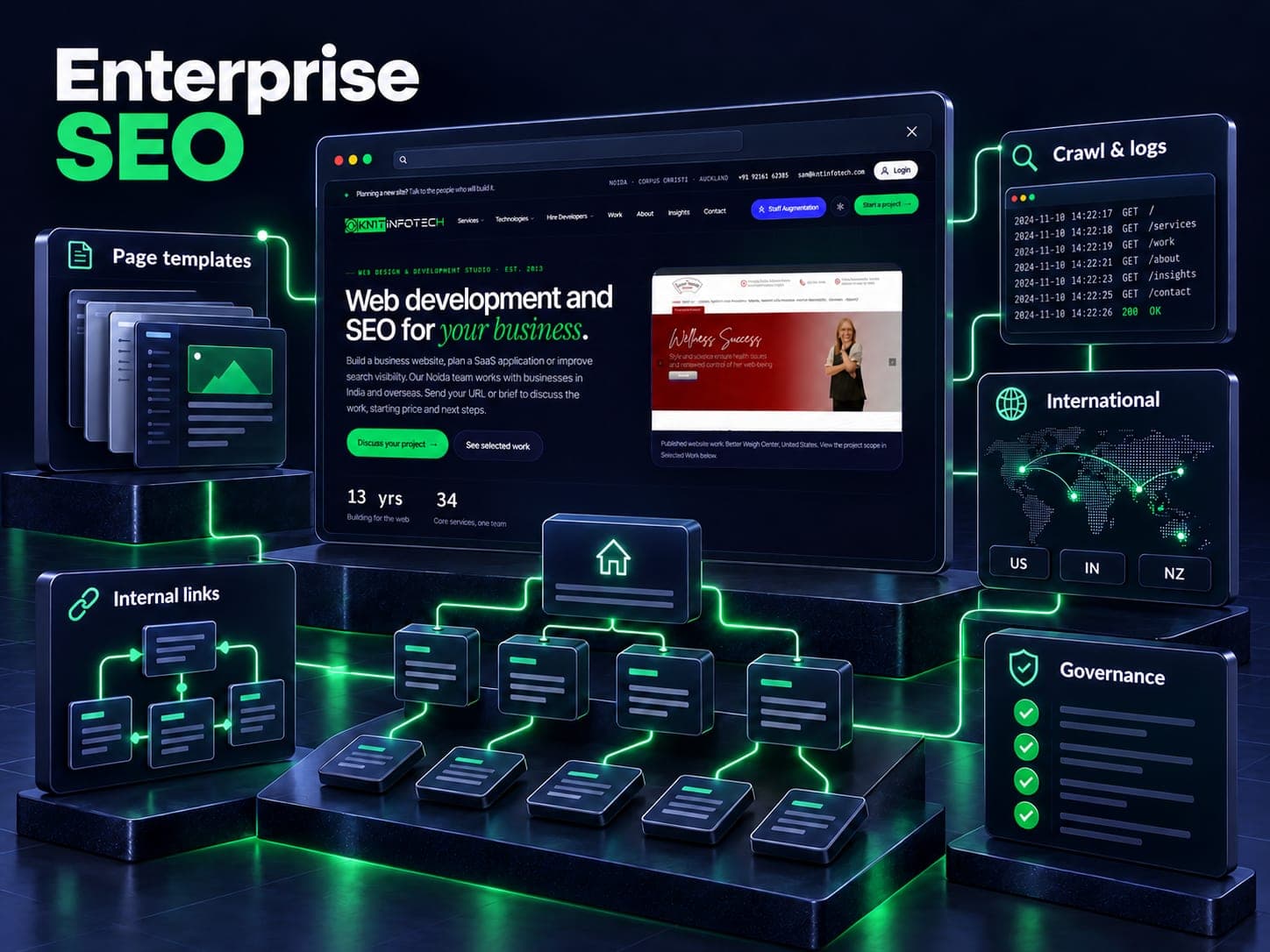
Review the systems that create the pages
A large catalogue, publishing estate or international site can generate many URLs from a small number of templates. Begin with the inventory, search evidence and verified crawler logs. Investigate index coverage, faceted navigation, duplicate variants, lifecycle rules and the pages the business actually needs discovered.
Crawl budget is one possible concern on a large site. It should be established from the scale and evidence rather than used as a default explanation for every indexing problem. Template quality, useful content and implementation ownership still matter.
Turn the findings into work the team can ship
Each recommendation needs an affected template or URL family, supporting evidence, an owner and an acceptance check. Prioritise against business value and implementation cost. A staged rollout makes it possible to observe whether the change behaves as intended before applying it broadly.
International work also needs accurate language and market relationships, suitable regional content and a plan for maintaining those variations. If the platform is preventing necessary changes, a website migration or redesign may need its own scope.
Separate implementation from search outcomes
Record the release, public response checks and subsequent Google crawl. Report index inclusion and relevant demand separately from a successful deployment. The programme should make decisions and progress reviewable across engineering, content and commercial teams without promising a particular index count or ranking.
Related reading: replatforming.
What enterprise SEO includes
Log-file & crawl analysis
What Googlebot actually requests, how often, and which sections it has quietly stopped visiting. Then a list of what to stop it crawling.
Template optimisation
Titles, headings, schema, internal links and render performance changed once in the template and inherited by every page below it.
Internal linking at scale
Rule-based linking modules that push authority towards the pages that convert, rebuilt as the catalogue or content library changes.
International SEO
Hreflang that validates, a market structure that does not fight your CMS, and a content plan per country.
Content governance
Standards, page templates and a review step, so the writers in your marketing team publish rankable pages without asking us first.
Stakeholder reporting
Impact estimates in the ticket, a single ranked backlog, and a monthly steering session with the people who set the sprint.
How we work with your team
Discoveryweeks 1–2
Who owns what, which platforms are involved, how releases happen, and access to analytics and raw server logs.
Technical baselineweeks 2–4
Crawl, logs, index coverage and a template inventory, with every finding ranked by how many pages it touches.
Template roadmapweek 4
Tickets written for your board, estimated, and sequenced to fit the release calendar rather than ours.
Ship & verifyongoing
Every release checked in logs and Search Console before the next one goes in, so a regression cannot hide behind three other changes.
Steermonthly
A monthly session with decision-makers and a quarterly re-rank of the backlog against what the business now cares about.
Tools and platforms
Starting from USD 999/month
A defined enterprise SEO workstream. Multiple sites, languages, large migrations and extensive engineering require a scoped proposal.
Enterprise SEO, answered
What counts as enterprise SEO?
Roughly: more than ten thousand URLs, more than one team touching the site, and a release process that stands between a recommendation and a live change. The technical work overlaps heavily with ordinary SEO. How it gets delivered does not.
How do you manage SEO across thousands of pages?
By template and by rule, never page by page. We inventory the templates, fix each one once, automate the internal linking, then verify with logs and index coverage that the change reached the pages we expected it to reach.
What technical issues are specific to large sites?
Crawl budget spent on rubbish, faceted navigation multiplying URLs, canonicals that disagree between templates, JavaScript rendering that hides content from the first pass, and redirect chains left behind by two migrations ago. Log files expose all five.
How do you work with our in-house team?
One named lead on our side, one backlog, tickets written in your tracker with impact estimates, and a monthly review with whoever prioritises the sprint. Your developers ship the changes; we specify and verify them. Decks are not the deliverable.
How much does enterprise SEO cost?
Starting from USD 999/month. A defined enterprise SEO workstream. Multiple sites, languages, large migrations and extensive engineering require a scoped proposal. The proposal confirms the work, fees and responsibilities before you commit.
How long before it shows in traffic?
The baseline takes about a month. First template releases usually land in the first quarter and show up in traffic during the second, assuming a normal release cadence. This is a programme with a compounding curve, not a project with a launch date.
Let’s review your site’s SEO priorities
Share the site scale, affected templates and available search or crawler evidence. We can agree the first workstream, implementation owner and acceptance checks.