

SaaS MVP development
A focused first release with a clear handover
Build the core workflow your first users need. We scope screens, data, permissions, billing and integrations, develop the application and agree testing, deployment and handover before the first release.
Starting from USD 6,999/projectFinal scope and price agreed before work starts.
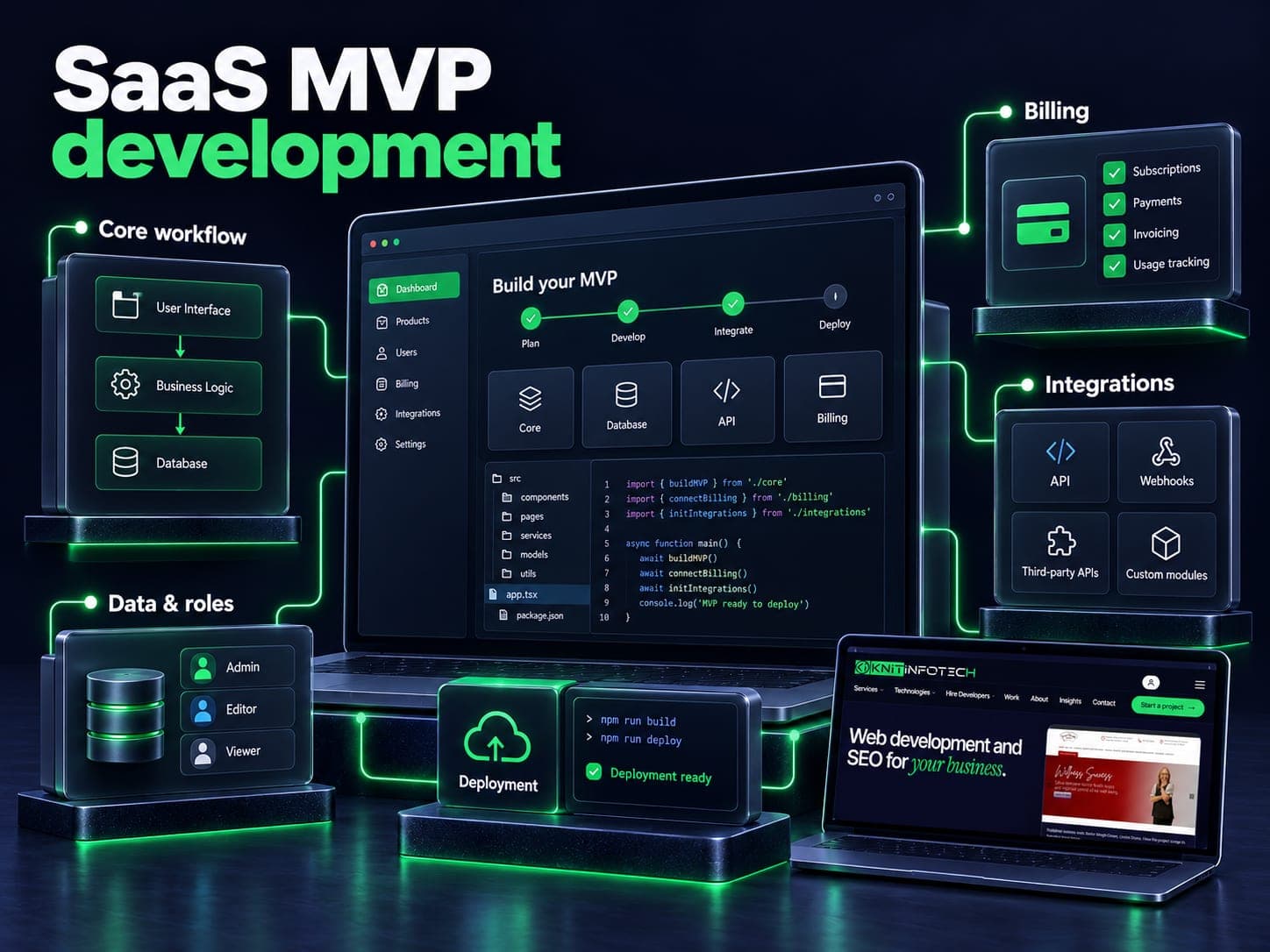
Build the first useful version
A SaaS MVP needs one clear user and one useful task. Tell us who will use the product, what they do today and what the first release must prove. We turn that into a short feature list, screen flow and acceptance checks. Features that can wait stay outside the launch scope.
A focused web application starts at USD 6,999/project. That is a starting fee for an agreed first release, not a fixed price for every subscription platform. Multiple organisations, complex permissions, financial workflows, native mobile apps and extensive integrations change the work involved.
Agree the product before the build
We identify the screens, user roles, data model and external systems the application needs. Authentication, billing and email are included where the proposal lists them. A subscription product also needs decisions about cancellations, failed payments, access changes and support responsibilities. Those details belong in the scope before development.
A Next.js front end with a suitable database can support this work. The stack follows the product requirements and the team that will maintain it. We explain platform subscriptions, payment-provider fees and hosting separately from the build price.
Review working software as it develops
The delivery plan sets review points, responsibilities and the launch criteria. Use a staging environment to check the core workflow with realistic test data. Review validation, permissions, error handling and payment events where relevant. Changes to the feature list are agreed with their effect on time and cost.
The handover covers the agreed source code, deployment setup, database changes and operating notes. Ownership and access terms are confirmed in the contract. Ongoing development can be scoped as a project or supported by a dedicated developer.
Send a brief that helps us price the work
A one-page outline is enough to start: intended users, the main task, any existing prototype, required integrations and your target date. We review it, share the questions that affect the build and prepare a proposal. A timetable is agreed after scope and content are clear.
What our SaaS MVP development covers
Next.js & fullstack TypeScript
App Router architecture with Server Actions, typed API routes, and shared TypeScript types between database models and frontend components.
Explore →PostgreSQL database & multi-tenancy
Relational schema design with Supabase, Prisma, or Drizzle, including Row Level Security (RLS) and clean multi-tenant isolation.
Authentication & permission roles
Turnkey authentication via Clerk or Supabase Auth: email magic links, social OAuth, session management, and role-based permissions (RBAC).
Stripe subscription billing
Tiered monthly and annual plans, self-serve customer billing portals, coupon management, tax calculations, and reliable webhook listeners.
AI capabilities & streaming
Custom prompt pipelines, retrieval-augmented generation (RAG), embeddings, and streaming text responses powered by Claude or OpenAI.
Explore →CI/CD & cloud deployment
Automated GitHub Actions pipelines deploying to Vercel or AWS Docker containers, complete with preview environments for every pull request.
Explore →From the product brief to launch
Scope lockdown & database schemaPlanning
We refine user stories, cut non-essential features, design the PostgreSQL schema, and finalize interactive wireframes for the core user flow.
Auth, database & billing foundationFoundation
Configure the database, authentication and any billing or email services listed in the agreed first-release scope.
Core product workflow & integrationsDevelopment
Build the agreed core workflow and integrations, then review working software with your team against the acceptance checks.
Testing, production deployment & handoverLaunch
Complete the agreed testing and launch checks, deploy to the approved environment and hand over the code, access and operating notes.
Starting from USD 6,999/project
A focused first release with one agreed core workflow. Screens, roles, integrations, testing and launch responsibilities are listed in the proposal. Enterprise platforms and larger multi-tenant products require a separate scope.
SaaS MVP, answered
How much does a SaaS MVP typically cost?
Starting from USD 6,999/project. A focused first release with one agreed core workflow. Screens, roles, integrations, testing and launch responsibilities are listed in the proposal. Enterprise platforms and larger multi-tenant products require a separate scope. The written proposal confirms deliverables, exclusions, timeline and the final price before work starts. Hosting, licences, platform subscriptions and usage charges are separate where required.
Who owns the intellectual property and code?
Ownership, account access, payment and handover follow the signed agreement and our terms. Confirm these arrangements before work starts. Repository and account responsibilities are confirmed in the project scope.
Can your team continue maintaining and scaling the product after launch?
Yes. Ongoing maintenance and product development can be agreed after the first release. The scope identifies support responsibilities, response expectations, monitoring and the development time reserved. You can also discuss a dedicated fullstack developer for continued work.
What if we discover we need to change a feature mid-build?
We review the change and explain its effect on scope, cost and delivery dates before starting it. You can reprioritise the release, defer another feature or agree additional work. The updated decision is recorded so both teams know what has changed.
Will the codebase hold up when we start getting real traction?
Capacity depends on the product, database queries, third-party limits and hosting. We agree expected usage and relevant testing in the scope. After launch, monitoring and real usage guide the next capacity decisions. A particular user count is not promised by choosing a framework.
How does timezone communication work for US and European founders?
Engineering delivery is from our in-house Noida team. Working days and collaboration windows are agreed before onboarding using the client’s timezone and the date. Daylight saving and the proposed team’s schedule affect the available overlap. Contracts, currency and payment arrangements follow the written proposal.
Let’s plan your first product release
Share the intended users, main task, prototype and required integrations. We can discuss a focused first release and prepare a scoped proposal.