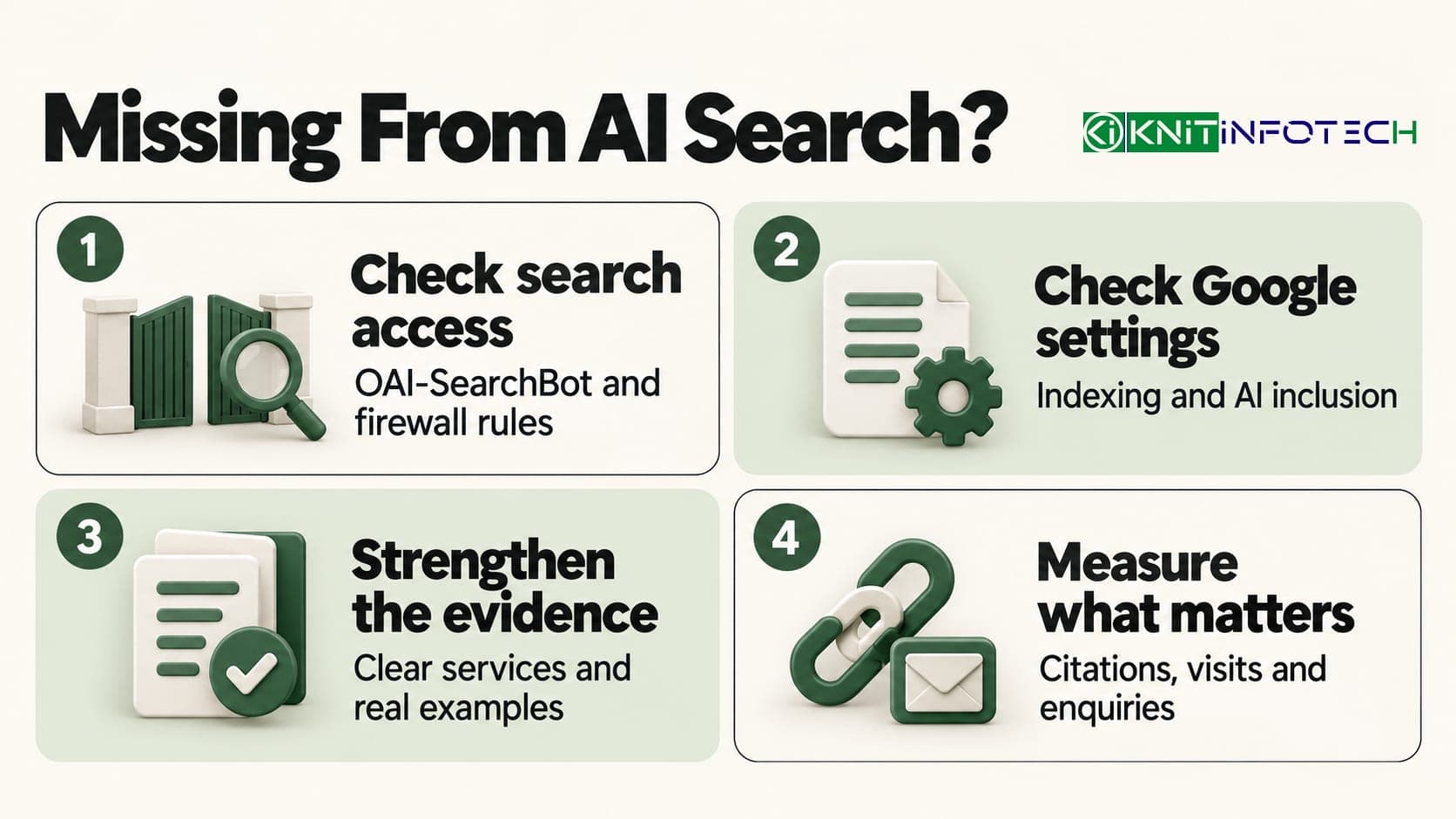
- Save the exact question, answer and sources before concluding why your business was omitted.
- Check ChatGPT search crawling separately from model-training preferences.
- Review Google indexing, snippet eligibility and the current generative AI inclusion setting.
- Useful service facts and verifiable evidence deserve more attention than repeated prompt-based pages.
- Measure access repairs, visibility observations, referrals and qualified enquiries separately.
Start with the result you are actually testing
Is your business not showing in ChatGPT, even when you ask about a service you offer? Save the question and the answer before changing the website. A missing mention can have several causes, and one answer does not tell you which one applies.
First, check whether the conversation used web search. Then distinguish a search for your business name from a request to compare suppliers. Finding the homepage by name and selecting it as a useful source for a broader question are different tasks. ChatGPT search visibility can vary with the wording, location, available sources and the context of the conversation.
For a small review, choose a few questions that a real buyer might ask. Include your business name, a service comparison and a location-specific request where relevant. Record the date, engine, question, citations and any incorrect business facts. Keep the original response so the next person can inspect what actually happened.
The same discipline applies to Google AI search. Check the feature and query you used. A traditional search result, an AI Overview and an AI Mode answer are different observations. Avoid treating one screenshot as your business’s permanent position.
Match the symptom to the next check
Use this as a starting worksheet. The checks can reveal a problem; they do not prove why a particular generated answer selected another source.
| What you notice | Evidence to collect | A useful next step |
|---|---|---|
| The business is absent from one answer | Exact question, search activity and cited pages | Repeat a small set of realistic customer questions |
| A public page cannot be fetched | Response status, crawler identity and security event | Investigate the specific block or challenge |
| Google has not indexed the page | URL Inspection, canonical and indexing settings | Correct the issue shown by the inspection |
| Google indexes the page but AI features omit it | Snippet eligibility and generative AI inclusion control | Review the settings, then assess relevance and evidence |
| The answer gives outdated business details | Website, eligible profiles and the cited source | Correct the information at its maintained source |
| Reports show mentions without enquiries | Cited URLs, referrals and accepted leads | Check the landing page and the next customer step |
A useful diagnosis names a URL, an observed issue and a person responsible for the repair. “Your AI SEO is weak” is too vague to act on.
Check ChatGPT search access and crawler settings
Ask your developer to review the public pages you want discovered, their robots.txt rules and genuine crawler requests. OpenAI documents three agents with different purposes:
| Agent | Purpose | What to check |
|---|---|---|
| OAI-SearchBot | Automatic crawling for ChatGPT search | Search access rules and requests from published search IP ranges |
| GPTBot | Crawling that may support model training | The business’s separate training preference |
| ChatGPT-User | Certain visits triggered by a user | Individual fetch behaviour; it does not determine search eligibility |
Allowing search access does not require allowing training. OpenAI says an OAI-SearchBot opt-out prevents inclusion in search answers, although a navigational link may still appear. Follow the current OpenAI crawler documentation, including its linked IP lists, rather than copying an old list from a blog.
After correcting a rule, check whether genuine requests can receive the intended public page. A successful fetch is evidence of access. It is not evidence that an answer will recommend the business.
Keep private accounts and administrative areas protected. Search discovery concerns the public information you have chosen to publish.
Have the site owner approve the intended policy, then verify the relevant public-page requests. A successful fetch demonstrates access; it does not establish recommendation or placement.
Investigate firewall challenges before rewriting the content
A browser can show you a page while an automated request receives a challenge, a blocked response or a different document. That difference is worth checking before commissioning a large content rewrite.
If the site uses Cloudflare, inspect the matching Security Event, requested path and rule. Its current documentation distinguishes policies for search crawlers, agents acting on a person’s behalf and training crawlers. A setting described as an AI-bot control does not tell you, by itself, which request was blocked. Review the current Cloudflare AI-bot controls with the owner.
Verify the crawler’s identity using the provider’s current guidance. A request that merely claims a familiar user-agent name is not sufficient evidence. Correct a confirmed false positive at the relevant rule while keeping the rest of the site’s protections in place.
Cloudflare’s Bot Fight Mode and Super Bot Fight Mode have different exception behaviour. Its false-positive guidance explains those limits. Avoid a blanket instruction to disable protection or assume one Skip rule bypasses every product.
The same investigation should check ordinary failures: a retired URL, broken redirect, unavailable server or page that requires authentication. Record what the crawler actually received, then retest after the repair.
Check Google indexing and AI feature eligibility separately
For a priority page, use Search Console’s URL Inspection and Page Indexing information. Review the public response, selected canonical and any noindex directive. A page may be accessible to a browser while excluded from the index or treated as a duplicate of another URL.
Google needs to fetch a page to discover its noindex instruction. A robots.txt block can prevent that fetch, and putting noindex inside robots.txt is unsupported. Follow Google’s indexing-control guidance when correcting a specific exclusion.
Google says supporting links in AI Overviews and AI Mode must be indexed and eligible to appear with a snippet. Eligibility still leaves Google to choose the sources relevant to an answer. Review its AI features documentation rather than interpreting an indexed page as a promised AI placement.
There is also a control that older checklists may miss. As of this article’s publication, Google documents a Search generative AI setting in Search Console. Check Settings, then Search generative AI, including whether the property inherits a parent’s exclusion. Review the current inclusion-control documentation before changing the owner’s preference. This control is separate from model-training choices.
Once technical access and settings are understood, examine the page itself. Repeatedly requesting indexing cannot replace a useful page or make a search engine select it for every answer.
Bring your URL and the result you are concerned about. Agree a review of public-page access, search settings and content gaps, with recorded evidence and prioritised repairs.
Give the relevant page something useful to contribute
An accessible page can still leave a buyer’s question unanswered. Read your priority service page as someone comparing suppliers: what can they learn here that helps them choose?
Consider a hypothetical commercial cleaning business. A homepage saying “quality cleaning at competitive prices” gives little help to someone comparing an office contract with a one-off deep clean. The website could explain the scope of each service, actual coverage, access arrangements, exclusions and the information needed for a quote. Approved project examples could show what the business did without inventing a result.
That exercise produces practical content decisions:
- Put the answer on the page that owns the service or question.
- Explain suitability, process, limitations and the next step in plain language.
- Show permitted examples, original photographs or specific work records.
- Give prices their scope, currency and exclusions when publishing them.
- Link related guides and services where they help the reader continue.
- Identify who checks facts and removes information that has become outdated.
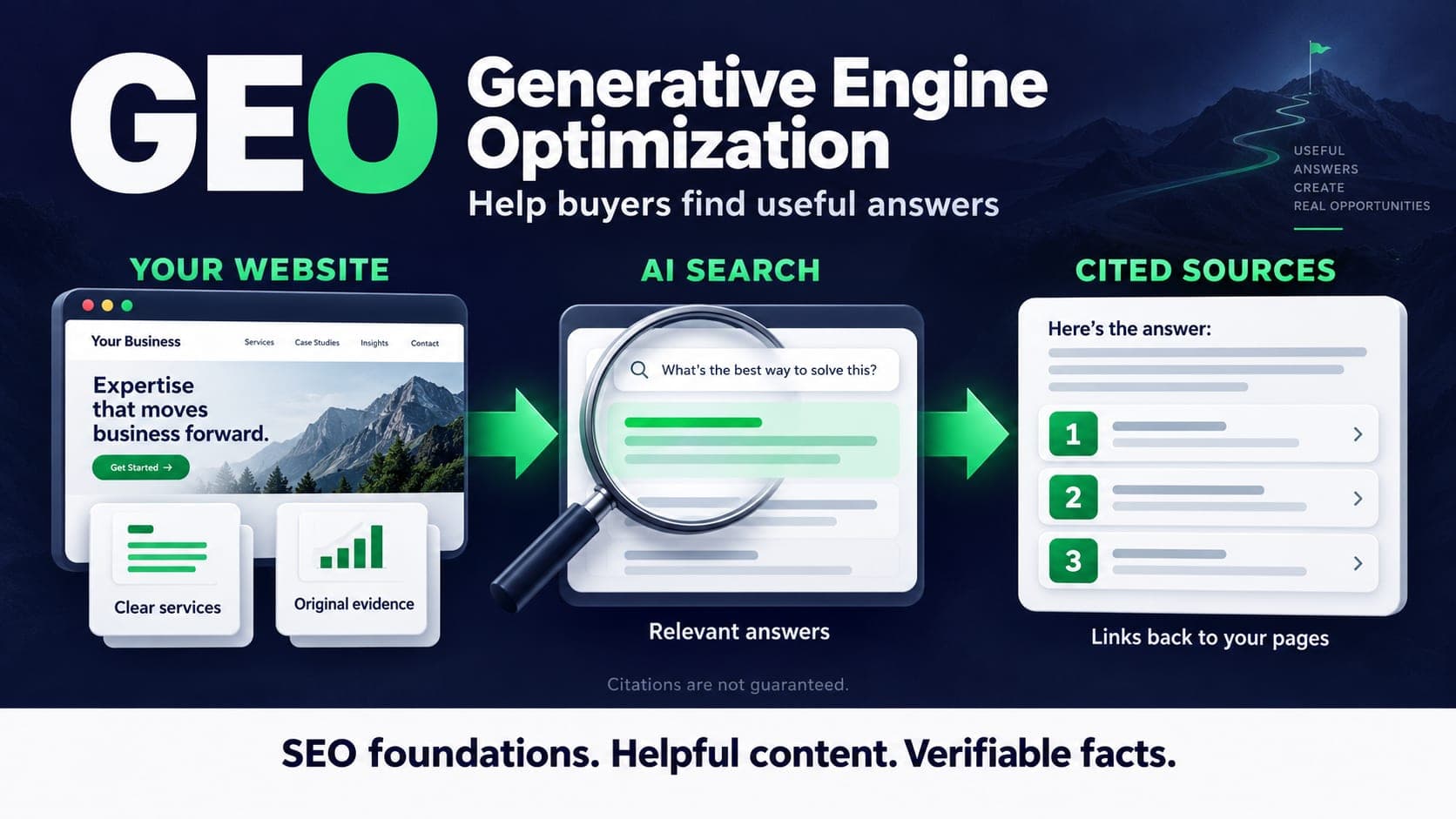
This is also the basis of useful Google AI search optimization. Google’s current optimisation guide connects its AI features to foundational SEO and useful, original information. It does not require a special AI schema or llms.txt file.
Avoid publishing a separate near-duplicate article for every wording of a prompt. Add a page when it has its own audience, evidence and decision to cover. Our GEO guide explains how this overlaps service content, internal links and ordinary search work.
An audit should compare what is missing from your pages, not simply count how often a competitor repeats a keyword. Better information can make a page more useful without guaranteeing that a particular answer cites it.
Make business details easy to verify
Check your business name, real location or service area, contact details and current offer. Keep those facts consistent across the website and the profiles you maintain. Explain remote delivery honestly; serving a city does not establish a staffed office there.
For an eligible local business, review the Google Business Profile’s category, hours, contact information and representation of the actual operation. Google’s local ranking guidance explains the role of accurate information alongside relevance, distance and prominence. A profile improvement is not a promise of a ChatGPT recommendation.
Look at the sources behind incorrect answers. If an old page, directory or profile supplies outdated details, correct that maintained source where you can. Do not spread a second set of facts across new pages and hope the contradiction disappears.
Use structured data only for information the page actually supports. Adding reviews, offices, awards or expertise you cannot substantiate creates an accuracy problem. A larger block of markup does not compensate for unclear service information.
Our local SEO service covers eligible location work; the broader SEO service covers site and content priorities. Choose the scope from the problem found in the review.
Measure visibility, visits and enquiries as separate outcomes
Keep a modest observation log: question, engine, mode, date, location context, cited URL and any factual error. Repeat a consistent sample. Record omissions as well as mentions. This is a practical review method, not an official cross-engine ranking formula.
Google now documents a dedicated Generative AI performance report for Search, covering impressions from AI Overviews and AI Mode. It supports dimensions including pages, countries, dates and devices. The report may not appear when a property has insufficient impressions. See the current report documentation. It does not measure ChatGPT or every answer engine.
Alongside visibility observations, review recorded referrals, the pages people land on and the enquiries your team accepts. Referral data can be incomplete. A rise in direct traffic or branded searches does not establish that an AI answer caused it.
Make the reporting useful to the business:
| Measure | What it can show | What it does not prove |
|---|---|---|
| Public-page fetch | A checked request received the intended content | The page will be indexed or cited |
| Search visibility observation | A page or business appeared in a recorded test | A permanent position across all users |
| Recorded referral | A visit attributed to a source by the available tracking | Every visit influenced by that source |
| Qualified enquiry | A received request matched the business’s criteria | The cause of the request without supporting evidence |
If the website receives visits but few suitable requests, inspect the offer and enquiry path too. Search visibility is only useful when the visitor can understand the service and take an appropriate next step.
Work through a repair order your team can finish
Start with evidence that can be checked and a repair that has a clear owner.
- Save the original questions, answers and cited sources.
- Test priority public URLs and investigate actual access failures.
- Review indexing, canonical and AI-feature settings with the site owner.
- Improve the service facts, evidence and missing buyer answers on the relevant pages.
- Check internal links, mobile layout and the complete enquiry process.
- Retest the repaired issue, then compare visibility and business outcomes over a defined period.
A technical fix should have a technical verification: the right content is served, a mistaken directive is removed, or a confirmed crawler block is resolved. A content improvement should have a named page, approved facts and a reason it helps the customer.
Agree a follow-up period suited to the site and the available data. Crawling, indexing, answer selection and buying decisions happen on different schedules. None should be sold as a guaranteed citation deadline.
What a useful AI search audit should deliver
A useful AI search audit should leave you with the URLs checked, evidence of issues found, prioritised repairs and a way to verify each change. It should also explain what remains uncertain.
The first brief can be short. Send your website, target service and market, a few customer questions and examples of the answers you are concerned about. Include recent migrations or security changes. This helps distinguish an access problem from a content gap before you commit to a larger programme.
Our AI Search Optimization service can review public-page access, search settings, service information and measurement within an agreed scope. If the review identifies website changes, we can discuss them alongside web development.
Request an AI search visibility review with your URL and the problem you have observed. The proposal should define the work and evidence you will receive, with rankings and citations treated as outcomes to measure.
Review the technical and content work in one agreed scope. The deliverable should name the issues, owners and checks rather than promise a ranking or citation.
Questions
Why is my business not showing in ChatGPT?
Start by saving the exact question and checking whether web search ran. Then investigate public-page access, service relevance, current business facts and the cited sources. One missing answer cannot identify the cause or establish a penalty.
How can I appear in ChatGPT search?
Review the search-access controls described by OpenAI, publish useful public information and keep business facts current. Verify any access repair, then observe relevant searches over time. Discovery and selection are separate steps; inclusion cannot be guaranteed.
Does allowing GPTBot make ChatGPT recommend my business?
No. GPTBot concerns potential model-training use, while OAI-SearchBot manages automatic search crawling. Review the intended search and training policies separately with the site owner.
Is Google AI search optimization different from ordinary SEO?
Much of the practical work overlaps: accessible public pages, useful content, accurate facts and appropriate internal links. Google also documents feature-specific eligibility and an inclusion control. A separate label or score should not obscure the actual tasks being proposed.
Does my website need special AI schema or llms.txt?
Google does not require a special AI schema or llms.txt for its generative search features. Use accurate structured data where appropriate and follow each service’s documented access controls. An extra file does not resolve a blocked page or an unclear service offer.
How soon will a technical repair make our business appear?
A repair can be retested for the issue it addresses. Crawling, indexing and source selection have separate processing and selection steps. Agree a follow-up plan and report the evidence available, without treating a deadline as a guaranteed mention.
What should an AI search audit include?
Ask for the URLs and questions checked, access and indexing evidence, factual and content gaps, prioritised changes and verification steps. Keep visibility observations separate from referrals and qualified enquiries. The proposal should explain both the deliverables and the limits of the review.
Sources
- OpenAI: search, training and user-triggered crawler purposes
- Google: AI features and website eligibility
- Google: current generative AI optimisation guidance
- Search Console: generative AI inclusion control
- Search Console: Generative AI performance report
- Google: noindex and indexing controls
- Cloudflare: AI-bot controls
- Cloudflare: investigating bot false positives
- Google Business Profile: accurate information and local ranking

Sam K (Santosh Kumar) founded Knit Infotech in 2013. Based in Noida, he works on web applications, ecommerce, CRM systems and workflow automation. He helps clients agree the scope and technical decisions behind a build.