

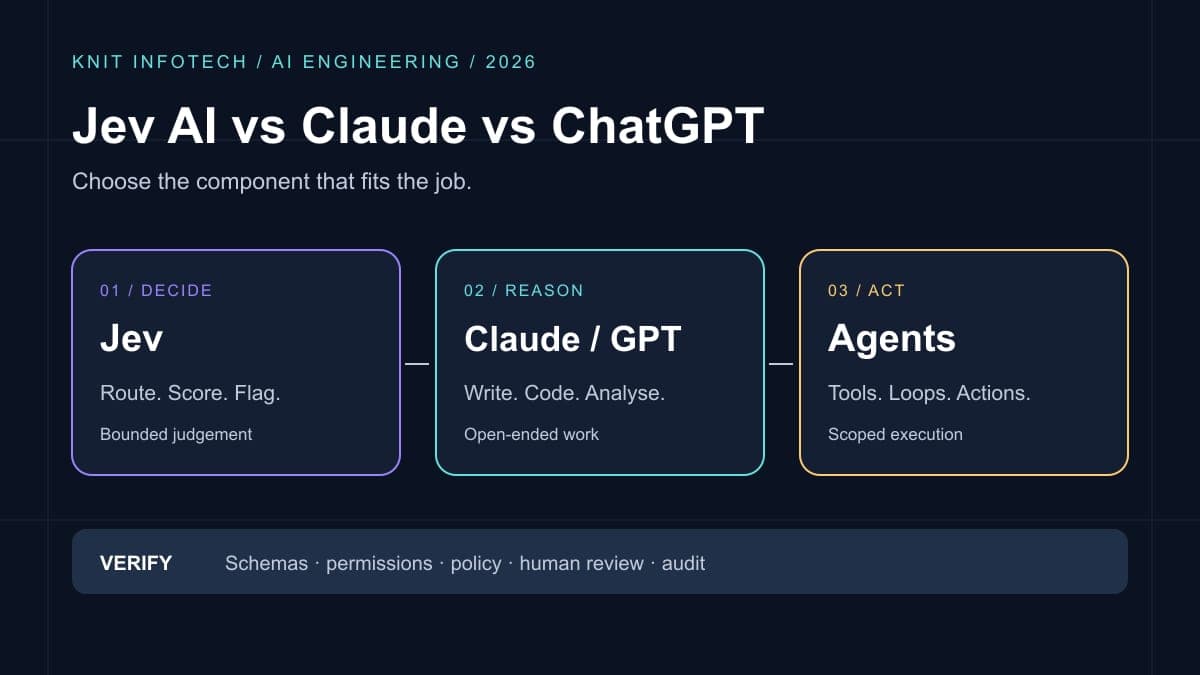
- Use code for exact arithmetic, dates, permissions and business rules.
- Jev returns typed decisions for bounded questions; a valid answer can still be the wrong answer.
- Claude and GPT handle open-ended reasoning, writing, coding and complex tool work.
- Agents connect models to tools and actions. Verification and approval belong in that system.
- OpenRouter measured Jev against Opus 5 on Banking77; those results do not establish performance against Opus 5.5 or on other tasks.
- Test confidence thresholds on your own data before automating a decision.
Quick answer
Jev is a fast decision model: give it state plus a bounded question and it returns a typed answer with probabilities. Claude and GPT are general models for reasoning, writing, coding and tool use. Agents are execution systems that wrap a model with tools, permissions and a loop.
For production software, keep exact rules in code, use a decision model for bounded judgement, use Claude or GPT for difficult reasoning or generation, verify the output, then let an agent act only through approved tools.
We reviewed TypeSafe, Anthropic and OpenAI documentation, plus an independent OpenRouter classification benchmark on 3 October 2026. Knit Infotech has not independently benchmarked Jev on production traffic for this article. Vendor performance claims are labelled as such.
Why the distinction matters
At 3:07 a.m., a customer writes: "I paid twice and I need this fixed before work tomorrow."
Before anyone drafts a reply, software may need to answer a few smaller questions. Is this billing or support? Is it urgent? Is there enough evidence to auto-route it, or should a person look first? None of those questions needs a polished paragraph. They need a decision.
For the last few years, many teams have sent both kinds of work to the same large language model. It works, but it is often an expensive way to solve a narrow problem. In 2026 the stack is becoming more specialised: small, bounded decisions can be handled by decision models; open-ended work still belongs to frontier language models; actions belong behind tools, permissions and verification.
The engineering question is not "Which AI wins?" It is "Which component should own this job?"
Jev vs Claude vs ChatGPT: the 60-second comparison
The table below compares roles, not winners. Prices are current list prices reviewed on 3 October 2026. Jev speed figures are vendor-reported unless a benchmark is named.
Specifications: TypeSafe, Claude Opus 5.5, Claude Sonnet 5.5 and GPT-6.1 Sol. Prices below are USD per million input / output tokens; API pricing does not describe ChatGPT subscription prices.
| Capability | Jev 1.13 | Claude 5.5 family | GPT-6.1 Sol |
|---|---|---|---|
| Primary job | Fast, bounded decisions | Reasoning, writing, coding, agents | Reasoning, coding, computer use, agents |
| Returns | Typed values + probabilities; Choice/Score also return confidence | Text, code, files, tool calls | Text, code, files, tool calls |
| Good fit | Routing, scoring, triage, moderation, ranking | Complex coding, documents, careful judgement | Coding, workflows, computer use, tool-heavy work |
| Poor fit | Free-form writing, exact arithmetic, date math, long reasoning | Millions of tiny latency-critical decisions | Millions of tiny latency-critical decisions |
| List price / 1M tokens | $0.042 input; output free | Sonnet 5.5: $2 / $10; Opus 5.5: $4 / $20 | GPT-6.1 Sol: $2 / $10 |
| Context / input | 64K request; 32K state + longest question; text only | Large-context general model family | 1.05M context; up to 128K output |
| Agent layer | Not an agent product | Claude Code / Claude agent tooling | Agents API / Codex / ChatGPT Work |
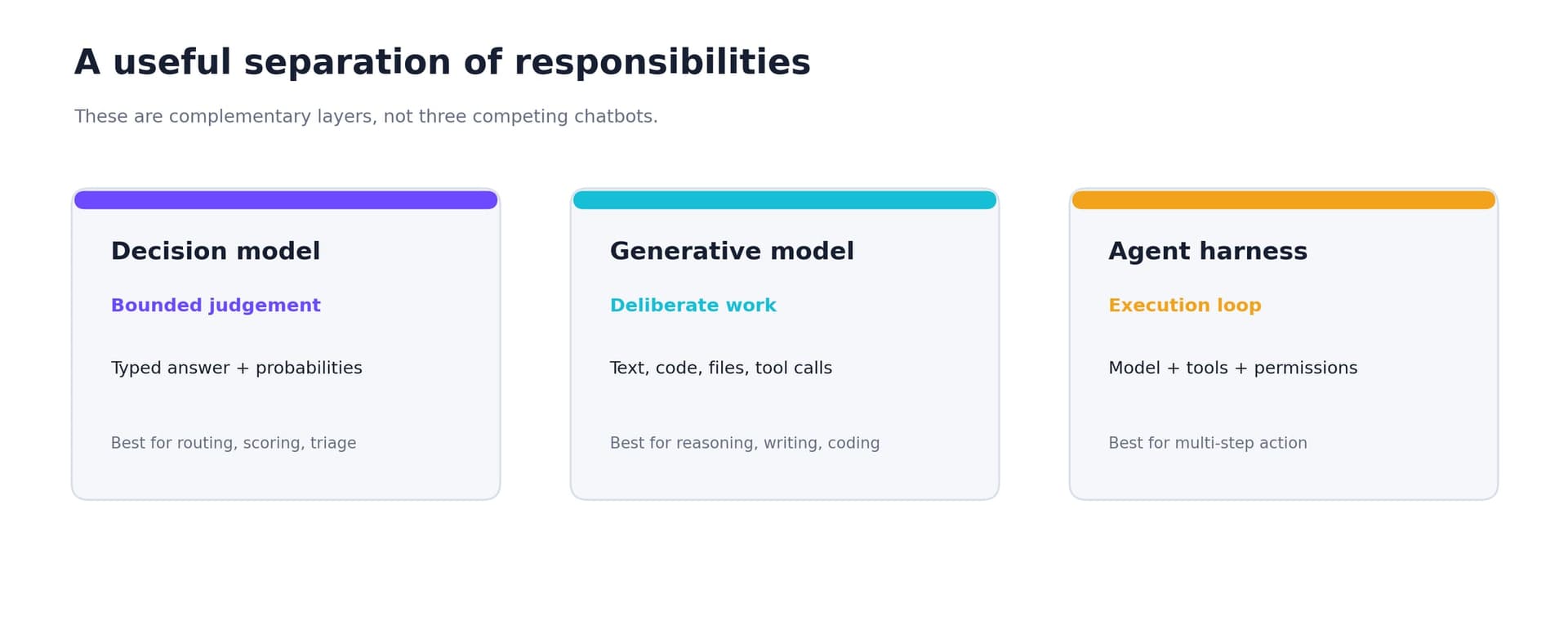
Decision models, generative models and agents solve different parts of the same software system.
What Jev actually is
TypeSafe launched Jev in early access on 15 September 2026 and describes it as the first public "System One" model. The name borrows from the fast/slow distinction popularised by Daniel Kahneman, but the engineering idea is more concrete: Jev is built to return structured decisions that software can consume directly, rather than sentences written for a person.
Source: TypeSafe launch announcement, 15 September 2026.
A request contains state - the facts the model should consider - and one or more typed questions. TypeSafe exposes three primitives: Choice chooses from a closed list, Score rates against ordered levels, and Noul returns a yes/no probability. Questions are evaluated independently against the same state.
Current Jev 1.13 documentation lists jev-1.13.0 at $0.042 per million input tokens, with output unmetered. The request limit is 64K tokens in total, with a separate 32K limit for the state plus the longest individual question. Input is text only. TypeSafe also warns that model aliases can move to a newer version, so production systems that tune thresholds should pin the version and log it with every decision.
Sources: Jev model limits and confidence documentation.
Type-safe does not mean always correct. Jev can be prevented from returning an option that your schema did not allow, but it can still choose the wrong allowed option. Type safety removes one class of failure; it does not remove judgement error. Likewise, Jev's confidence is a statistic derived from its probability distribution. Treat it as a routing signal to validate on your data, not as a guaranteed probability that the answer is correct.
What an independent benchmark actually shows
Vendor demos are useful for understanding a product, but they should not be the only evidence in a production decision. OpenRouter published a useful outside test on 22 September 2026 using the Banking77 dataset: 3,080 customer-support utterances across 77 banking intents.
| Banking77 result | Jev 1.13 | Claude Opus 5 |
|---|---|---|
| Classification accuracy | 81.0% | 84.4% |
| Median round-trip latency | 175 ms | 2,266 ms |
| Cost per 1,000 requests | $0.11 | $2.42 |
Source: OpenRouter Banking77 benchmark, published 22 September 2026. These figures are for Opus 5, not Opus 5.5.
On that test, Jev 1.13 reached 81.0% accuracy and Claude Opus 5 reached 84.4%. Jev's median client-observed round-trip latency was 175 ms versus 2,266 ms for Opus 5, while billed cost was $0.11 versus $2.42 per 1,000 requests. That is a meaningful speed and cost difference, but it is not evidence that Jev is "better than Claude". It shows that a specialised decision model can be competitive on one bounded classification task.
The more interesting result was routing. In OpenRouter's data, Jev was 96.3% accurate on the 58% of examples where its confidence was at least 0.99. Sending everything below 0.90 confidence to Opus 5 recovered 84.0% overall accuracy at $0.69 per 1,000 requests - close to Opus 5 alone, at much lower cost. That is exactly the pattern a production system should test: fast model first, expensive model or human only when the first layer is uncertain.
This benchmark compares Jev 1.13 with Claude Opus 5, not the newer Opus 5.5. It is one dataset, one provider path and one classification problem. Do not extrapolate it to coding, writing, research or agent work.
Where Jev breaks - and what should stay in code
TypeSafe publishes a "jaggedness" page for Jev 1.13, and it is one of the most useful pieces of the documentation. The short version is that Jev is strongest when the question is narrow, semantic and literal. It gets weaker when the task drifts into calculation, long chains of reasoning or noisy context.
| Failure mode | What to do instead |
|---|---|
| Arithmetic, counting, numeric precision | Calculate in deterministic code. Ask the model only for the judgement around the number. |
| Date and time comparison | Extract the parts if needed, then compare dates and durations in code. |
| Large state with irrelevant detail | Retrieve and filter first. Send only the fields the question needs. |
| Indirection or contradictory criteria | Rewrite as atomic, literal questions; combine the answers in code. |
| Adversarial text inside state | Treat state as untrusted input. Test injections and never make the model your authorization boundary. |
| Free-form generation | Use Claude, GPT or another generative model. |
If code can compute it exactly, code should compute it exactly.
This is also where the "more context is always better" habit becomes dangerous. TypeSafe explicitly says Jev suffers when state is filled with irrelevant material. For a decision layer, retrieval and filtering are not optional optimisations; they are part of accuracy.
Source: TypeSafe Jev 1.13 failure modes.
Claude and GPT still own the hard, open-ended work
The rise of decision models does not make general models less important. It makes their job clearer. Claude and GPT are built for work where the answer is not a closed set: understanding an unfamiliar codebase, writing a customer explanation, comparing long documents, investigating an incident, drafting a proposal, or coordinating tools across a long task.
Claude Opus 5.5 and Sonnet 5.5
Anthropic released Claude Opus 5.5 on 22 September and Claude Sonnet 5.5 on 28 September. Opus 5.5 is positioned for complex, long-running work and lists at $4 input / $20 output per million tokens. Sonnet 5.5 is the faster, lower-cost everyday model at $2 / $10, aimed at well-scoped coding, debugging and document work. Anthropic reports that Sonnet 5.5 generates output more than 30% faster than Sonnet 5; that is a vendor result, not a guarantee for every workload.
GPT-6.1 Sol and the agent stack
OpenAI released GPT-6.1 Sol on 29 September 2026 for complex coding, computer use and professional work. The API lists a 1.05M-token context window, up to 128K output tokens, and standard pricing of $2 input / $10 output per million tokens for prompts within the standard pricing band. OpenAI's Agents API had already entered public beta on 10 September; on 29 September, OpenAI added computer use to it.
Sources: GPT-6.1 Sol specifications and pricing, Agents API documentation and DevDay announcements. For GPT-6.1 Sol, prompts above 272K input tokens have higher rates; the table shows standard pricing within that threshold.
That timeline matters because an agent is not a separate kind of intelligence. It is a harness: a model, a loop, memory or context, tools, permissions and an execution environment. The model reasons; the agent architecture decides how that reasoning is turned into work.
The quiet signal: OpenAI is also separating "decide" from "reason"
At DevDay, OpenAI previewed a Decisions API powered by Luna for classification, routing and choosing from predefined actions. It is still a limited preview and the details can change, so it should not be treated as a finished Jev equivalent. What it does show is that fast, bounded decision-making is becoming a distinct API category rather than a prompt pattern hidden inside a chat model.
Source: OpenAI DevDay 2026 recap. Decisions API was announced as a limited preview; availability may change after this review date.
That is the larger 2026 shift: not every request deserves the same model, the same latency budget or the same permissions.
The Knit Infotech DRAV framework: Decide, Reason, Verify, Act
The production failure we see most often is not that the model is "not smart enough". It is that one probabilistic step is given too many responsibilities at once. It classifies the request, interprets policy, writes the answer and triggers the action in the same pass. That is hard to test, hard to audit and hard to contain.
A cleaner architecture separates those responsibilities. We use DRAV as a simple design pattern:
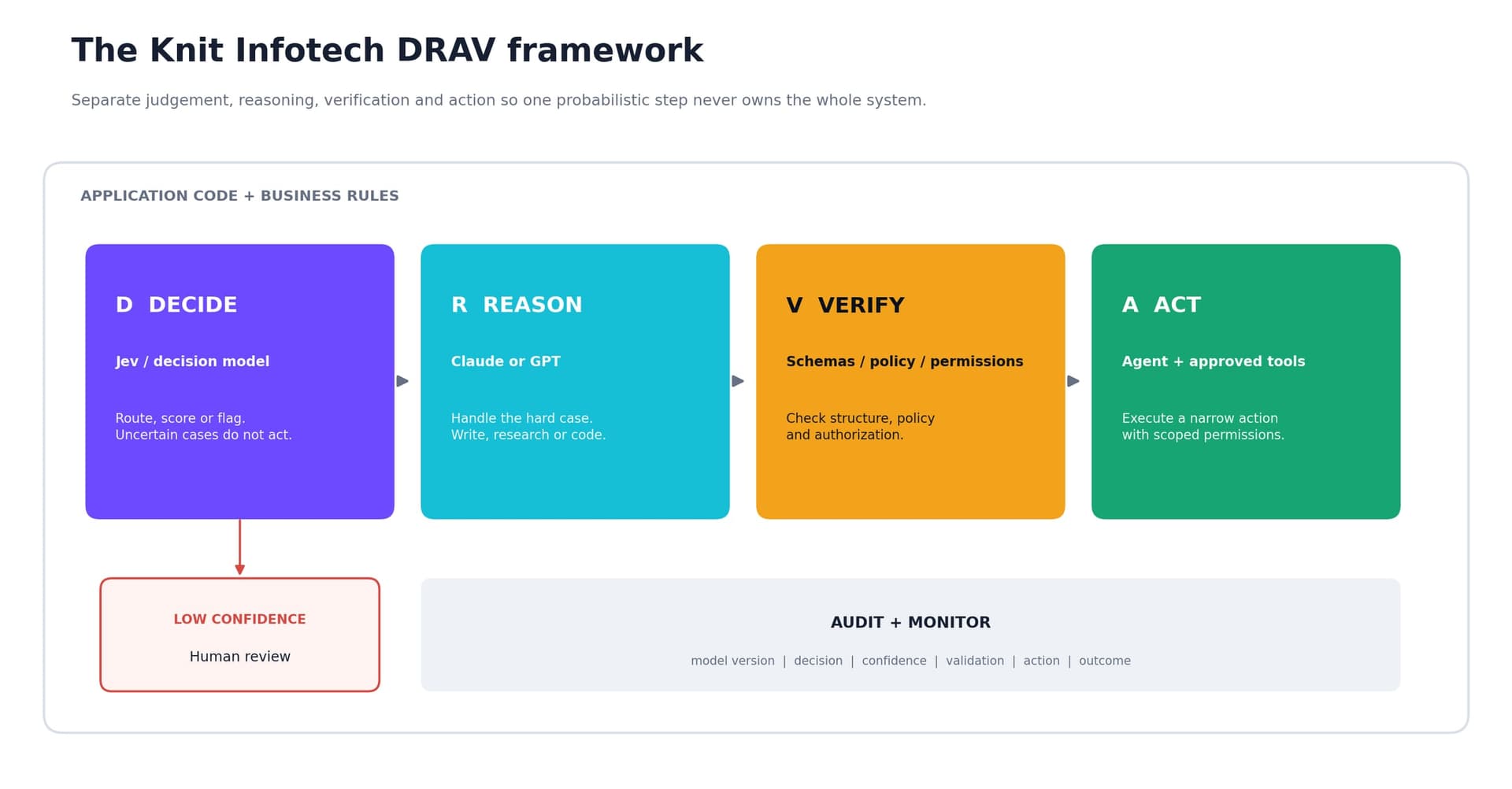
DRAV is a design pattern, not a product. Ordinary application code still owns permissions, exact rules and failure handling.
| Layer | Typical owner | What it should do |
|---|---|---|
| Decide | Jev, a small classifier, deterministic code, or Decisions API in limited preview | Route, score or flag. Uncertain cases do not act. |
| Reason | Claude or GPT | Handle the hard case, write, research, explain or code. |
| Verify | Schemas, policy rules, permissions, evaluators | Check structure, authorization and business constraints. |
| Act | Agent + narrowly scoped tools | Execute only the approved operation; record the result. |
The key is the boundary between layers. A model can recommend that an invoice be adjusted; it should not also be the only thing that decides whether the current user is allowed to issue that payment adjustment. Permission is deterministic. Money movement deserves explicit verification. High-impact actions deserve a human approval until the system has earned more autonomy.
What this looks like in real workflows
| Workflow | Decision layer | Reasoning / action layer |
|---|---|---|
| Customer support | Intent, urgency, payment adjustment category, confidence | Investigate edge cases, draft the reply, update CRM after approval |
| Sales / CRM | Lead intent, spam score, routing, priority | Research the account, write outreach, prepare proposal |
| Finance operations | Flag items that need review; classify document type | Investigate exceptions, write analyst summary; never let the model own arithmetic |
| Security operations | Triage severity and route alerts | Investigate root cause, propose remediation, execute only through approved tooling |
| Content operations | Quality or policy gate; classify topic and intent | Research, draft, edit, localise; human editor remains the publishing gate |
Notice what is missing: "send everything to the biggest model." Expensive models are most valuable where the task actually needs them. Cheap models are valuable only when their boundaries are clear.
Security: typed output is not a security boundary
Jev's structured output makes downstream code easier to validate, but it does not make hostile input harmless. TypeSafe explicitly notes that adversarial content in state can move Jev's answer. The same broader principle applies to agents using Claude or GPT: the more tools an agent can call, the more ordinary security engineering matters.
- Treat model input as untrusted. User text, retrieved documents and tool output can contain instructions you did not intend to follow.
- Keep authorization in code. A model may recommend an action; deterministic permissions decide whether it is allowed.
- Use allowlisted tools and narrow scopes. Give a workflow the smallest set of actions it needs.
- Require approval for destructive or financial actions. Deletions, payment adjustments, transfers, publishing and customer-facing changes need stronger gates.
- Log model version, inputs, decision, confidence, validation and final action. Without that chain, you cannot investigate a failure.
- Design rollback and idempotency. An automated action should be safe to retry or reverse wherever possible.
A five-step pilot before production
Do not start by swapping every classifier or workflow to a new model. Start with one decision that is high-volume, measurable and cheap to get wrong.
- Choose one bounded decision. Ticket routing, lead categorisation or a moderation queue is easier to measure than "run customer support".
- Build an evaluation set from real historical cases. Keep the human decision and, where possible, the downstream outcome.
- Run in shadow mode. Let the new model make decisions without changing production behaviour.
- Measure accuracy, p50/p95 latency, cost and confidence routing. For imbalanced labels, include per-class precision/recall or macro-F1 rather than accuracy alone.
- Automate only the slice that earns it. Route uncertain cases to a stronger model or a person, then widen the automated range as evidence accumulates.
This article is a research review. A first-hand pilot should report the dataset, model version, measured p50/p95 latency, cost per 1,000 decisions, accuracy by class and escalation rate before anyone claims production results.
The practical conclusion
Jev is interesting not because it replaces Claude or ChatGPT, but because it challenges a lazy architecture: using one giant language model for every fuzzy decision in a system. OpenAI's Decisions API preview points in the same direction. The more AI moves from chat windows into software, the more specialised the stack is likely to become.
For a real product, the cleanest question is simple: what can ordinary code decide exactly, what needs bounded judgement, what needs open-ended reasoning, and what is allowed to act? Once those four boundaries are explicit, model choice becomes much easier - and the system becomes easier to test, secure and operate.
Use intelligence where judgement is needed. Use code where certainty is available.
Build the workflow around your real process
Our AI workflow automation work starts with the process, its data and the people responsible for it. An AI readiness audit helps identify which steps can be automated and which need a clearer rule or a human owner first.
For the operational side, read AI agents for small businesses. For the systems they depend on, see modern web development and the technologies we build with.
If your next concern is how AI systems find and cite your business, our Answer Engine Optimization guide and AI search optimisation service cover that separate problem.
Bring us one real workflow for a 20-minute technical review. We can map which steps should stay deterministic, which need bounded judgement, which need Claude or GPT, and where a human approval gate belongs.
Connect intake, routing, drafts and approved actions around a process your team can measure and review.
Questions
What is Jev AI?
Jev is TypeSafe AI's first System One model. It takes application state plus typed questions and returns structured decisions, probabilities and - for Choice and Score - a confidence statistic your software can use for routing.
Is Jev an LLM?
TypeSafe does not position Jev as a conventional text-generating LLM. It is a specialised decision model with a different output interface and training objective, built around bounded, machine-consumable judgements.
Can Jev replace Claude or ChatGPT?
Not for general work. Jev is not designed to write, code or carry a long conversation. Claude and GPT remain the better fit for open-ended reasoning, generation and agent workflows.
Is Jev hallucination-free?
It is more precise to say that Jev is type-safe: it cannot return a value outside the answer space you defined. It can still make a wrong in-schema judgement, so production use still needs evaluation, thresholds and escalation.
How should confidence be used?
As a routing signal. High-confidence decisions may be automated when the stakes and measured error rate allow it; medium-confidence cases can be verified; low-confidence cases should fall back to another system or a person. Set thresholds from your own data.
What is OpenAI's Decisions API?
A limited-preview API announced at DevDay 2026, powered by Luna, for tasks such as classification, routing and choosing from predefined actions. Its design may change before wider release.
What is the difference between a model and an agent?
A model produces an answer or decision. An agent is a system around a model that can maintain context, select tools, take actions, observe results and continue. Permissions and verification belong to the agent system, not to the model alone.
Which should developers use?
Match the component to the job: deterministic code for exact rules, a decision model for bounded judgement, Claude or GPT for open-ended reasoning and generation, and an agent only when the system genuinely needs to take multi-step action.
Sources
- TypeSafe: Introducing System One Models & Jev
- TypeSafe: Introduction and System One concepts
- TypeSafe: Jev models, pricing and context limits
- TypeSafe: Jev 1.13 failure modes
- TypeSafe: Confidence
- OpenRouter: Jev 1.13 vs Claude Opus 5 on Banking77
- Anthropic: Claude Opus 5.5
- Anthropic: Claude Sonnet 5.5
- OpenAI: Agents API documentation
- OpenAI: GPT-6.1 Sol model specifications
- OpenAI: DevDay 2026 announcements and Decisions API preview

Sam K (Santosh Kumar) founded Knit Infotech in 2013. Based in Noida, he works on web applications, ecommerce, CRM systems and workflow automation. He helps clients agree the scope and technical decisions behind a build.